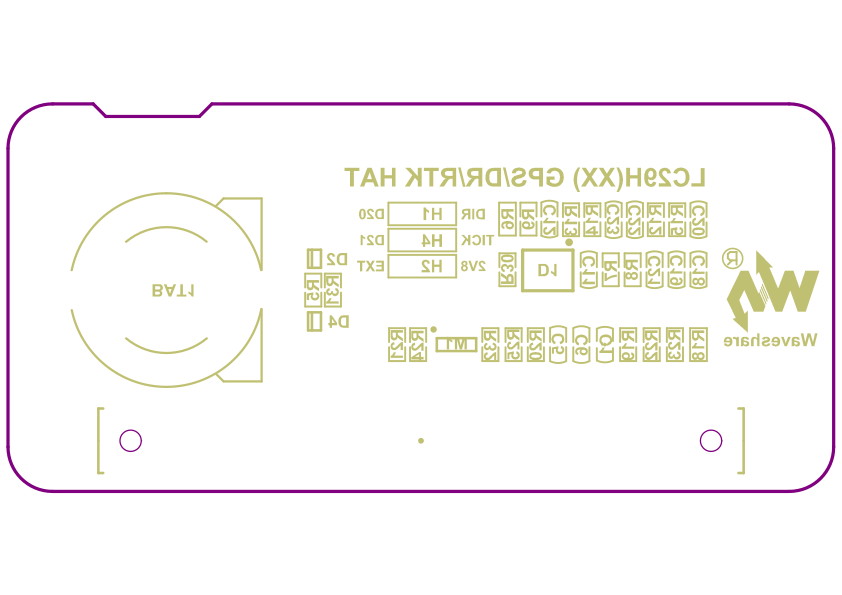
Hardware Schematic
Annotated walkthrough of the Waveshare LC29H GPS/RTK HAT schematic. The HAT connects the Quectel LC29H GNSS module to Raspberry Pi and Jetson Nano via the 40-pin GPIO header, with jumper-selectable UART/USB communication and onboard battery backup.
Power Supply
Section titled “Power Supply”5V from the Pi GPIO header (pin 2/4) feeds a 3.3V LDO regulator (ME6211) that powers the LC29H module. An ML1220 rechargeable coin cell battery provides backup power to the RTC and SRAM, maintaining ephemeris data and time across main power cycles.

GNSS Module and RF Path
Section titled “GNSS Module and RF Path”The LC29H module connects to the dual-frequency L1/L5 antenna via an IPEX 1st-gen (U.FL) connector. The integrated LNA (Low Noise Amplifier) and SAW (Surface Acoustic Wave) filter provide high sensitivity (-165 dBm tracking) with strong interference rejection.

UART Interface
Section titled “UART Interface”The primary serial interface routes through a jumper-selectable path. When set to position B, the module’s TX/RX lines connect directly to the Raspberry Pi’s UART pins (GPIO 14/15) via level-shifting circuitry.

USB Bridge (CP2102)
Section titled “USB Bridge (CP2102)”When the jumper is at position A, UART traffic routes through a Silicon Labs CP2102 USB-to-UART bridge to the USB-C connector. This provides an alternative communication path independent of the GPIO UART.

I2C Interface
Section titled “I2C Interface”The module’s I2C lines (SDA/SCL) connect to the Pi’s I2C bus (GPIO 2/3) through level shifters. I2C can be used for NMEA output and command transmission as an alternative to UART.

LED Indicators
Section titled “LED Indicators”Four status LEDs provide visual feedback:
| LED | Color | Function |
|---|---|---|
| PWR | Red | Power indicator |
| TX | Green | NMEA data transmission |
| RX | Green | Data reception from host |
| PPS | Blue | Pulse-per-second (position fix acquired) |

Full Schematic Pages
Section titled “Full Schematic Pages”Page 2 — Complete Circuit Diagram
Section titled “Page 2 — Complete Circuit Diagram”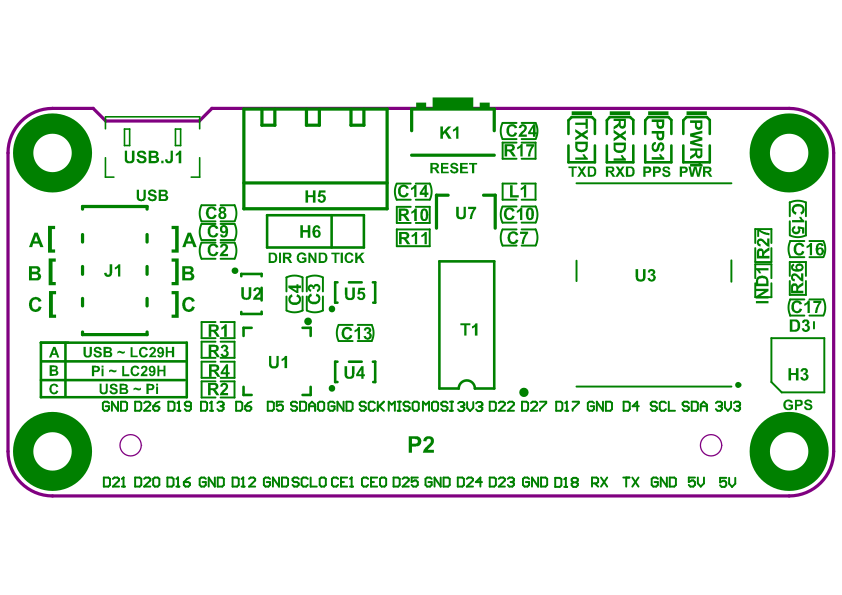
Page 3 — GPIO Header and Connector Pinout
Section titled “Page 3 — GPIO Header and Connector Pinout”